Blog Feed

NaPoWriMo 2022 Day 4 – Cop-Out

You look at me with green, accusing eyes.
There is no room upon my lap,
supplanted by computer.

I realised too late,
I have no poem today.
The Month of Fools
has had its fill of me,
(or I of it).

My day was filled with other stuff,
– returning on another train –
but I’ve exhausted those
(or they’ve exhausted me).

Abandoned by my words,
ungraciously acknowledging,
I must admit defeat.

Linda Rushby 4 April 2022

NaPoWriMo 2022 Day 3 – Caledonian Railways

Another train-related one, but not written on a train this time. Instead it was inspired by an image from the British Library Flickr feed of copyright-free illustrations which I’ve mentioned before

I didn’t quite get as far as Scotland, just visiting my daughter and family to celebrate a cluster of family birthdays which are happening this week (including mine).

Caledonian Railways

Cross the border to a different country.
Wheels on rails, and a distant whistle.
Lift your hand to the misty windows
Streams turn to lakes
and fields to mountains.
Leave the carriage
at an empty station.
Take your belongings.
Mind the gap.

Linda Rushby 3 April 2022

NaPoWriMo 2022 Day 2 – Writing on a Train

Writing on a Train

Writing on a train
Listen to the rhythm.
Ponies in a field, 
Blossom on the hedges 
Leaving home behind,
Heading for the future
Could be going anywhere. 

Moving through a life
See yourself reflected
Ghostly in the window 
Clouds and trees and places
Moments fly too quickly
Riding on a train

Linda Rushby 2 April 2022 #napowrimo

NaPoWriMo 2022 Day 1 – Month of Fools

Month of Fools

The Month of Fools has
come round again,
straddling the threshold
of winter and spring.

Daffodils bend
beneath snow flurries,
and blossoms scatter
from bitter storms.

But look again,
and there’s the sun,
teasing us fools
and spreading confusion.

Is this the best month
to be born a poet?
Or simply the cruellest of all?

Linda Rushby 01 April 2022

The Last Time I Saw Paris (Poem)

I don’t write much (hardly at all) these days, but here’s a poem that came into my head recently on the train to Southampton, inspired by some photos of Paris taken ten years ago, which had popped up on my computer earlier that morning.

The Last Time I Saw Paris

And that was Paris in the bitter end of winter,
gloves and woolly hats, and shoulders hunched
against the looming sky and constant drizzle.

Tourist queues outside the Louvre,
umbrellas by the Quai D’Orsay.
Bedraggled awnings on the Left Bank.

The Seine, grey and growling, spits dirty waves
in disgust at a sad busker
on the lower embankment.

Battered snowdrops in the Tuileries
and veteran Maquisards in flat caps and berets
blink rain from their rheumy eyes to see the boules.

Gloomy cafes and sulky waiters,
not even the coffee is warm enough.
Paris in the (not quite) spring.

Linda Rushby 25 February 2022

The Spurling Pipe

It was when I looked down at my foot pumping a few ‘pumps of air’ into the inflatable that I noticed I’d come out in my slippers – “oh well,” I thought “not much I can do about that, other than abandon the visit to Cracklin’ Rosie” – and I didn’t want to do that ‘cos I was on a mission: fitting the new, stainless-steel, spurling pipe – a high priority job.

It was a dark and stormy day, raining. Hatches had to stay shut, so not enough light came down below. And the read-out window of the electricity-socket pedestal on the pontoon had shown ‘no-credit’ when I pushed in my card. I learned later that if you allow the card to get too close to a mobile fone, it wipes the chip clean! What a con!

As it turned out, it didn’t matter much anyway. On a previous visit I’d moved everything out of the forepeak, bed-cushions included, to clear the construction site; one of the unforeseen consequences of that was that my wandering light and cable was buried in a cupboard behind haphazard layers of tools, cushions, going-home clothing and tins and boxes of things that are kept in unmarked tins and boxes on all boats.

Anyway, I had to illuminate complex bits of the job with a torch, not very satisfactory. And it was cold. And my paraffin heater fuel-pipe was disconnected. And, of course, I had no electricity.

I struggled on.

When it got really dark, I downed tools and treated myself to a small tot of the amber liquid while I cooked dinner. Baked beans. Very tasty.

My ‘Vang’ sleeping bag is warm and cosy, about the only thing that was fully functional on board that day. At least the roof didn’t leak.

I slept all night.

The morning almost didn’t make it. More dark clouds and rain. I had a lay-in, a case of Vang-itis.

I got up eventually and began the struggle again, dashing out between the showers to fit, temporarily, the spurling pipe deck-fitting in order to accurately locate the pipe retaining collar on the deckhead and the lower mounting frame above the chain locker, without displacing the deck fitting.

By late afternoon the dark clouds had got darker. Dense showers of rain were sweeping across the sea, flattening the waves.

I’d had enough. “I’m going home.” I said to the wind.

I gathered my bits, tidied what was to be left in the cockpit and launched the dinghy. Only a couple of hundred yards to row against the wind and the rising tide. “The exercise will keep me warm” I said to myself. I got that bit right.

I approached the side of the concrete slipway as fast as I could row. I needed the dinghy to ground hard on the concrete so that it wouldn’t be blown off as I stepped ashore.

I thought I’d done it. I leant forward into a crouching position and, pushing myself upwards and forward, raised my right foot and thrust it over the bow of the dinghy, and down… into two inches of water and thick, black mud. My body, and my left leg, followed.

The dinghy, suddenly freed of the constraining weight of me, began to drift downwind – but it couldn’t escape, my left foot was still aboard. All I had to do was turn around and grab it (the dinghy, not my foot).

Ho! Ho! My right foot was mud-bound, up to the knee.

I spun around, anti-clockwise, lifting my left foot as I did so. The dinghy, suddenly released, made a run for it. Instinctively (Harrogate, Army Apprentice College First XV, 1958) I dived – nearly unscrewing my right foot from its leg in the process – and draped an arm over the runaway dinghy. The other arm went into the mud.

Now all I had to do was stand up.

Unwilling to release the dinghy to the wilds of Fareham Creek, I had to fold my left knee under my body and thrust that into the mud too, that allowed me to unbury my ‘free’ arm to grab the dinghy’s grab-line and make a couple of muddy steps to the slipway, dragging the dinghy behind me.

The drama was all over. I fetched the dinghy-trolley from the dinghy compound and stowed the dinghy. I threw an old sheet over the driver’s seat in the car and drove to the security gate. (We always carry an old sheet in the boot, don’t you?)

I had to get out of the car to hand in the dinghy-compound key. The security guard stared at me, obviously worried. “Are you alright?” he asked.

I suppose his concern must have been aroused when he noticed that I was wearing my slippers.

Sometimes a Man Needs a Woman

The Spurling-Pipe Deck-Fitting, on Cracklin’ Rosie’s foredeck, used to face aft, I’ve always thought that was a mistake. Having it facing aft might have reduced the chances of unwanted waves pouring down into the forepeak but it also made pulling out the anchor chain a lot unsmoother than it should have been. ‘So’ thought I, ‘now, that she’s on land for a spell I’ll re-align said deck-fitting to face forward’. I undid its four mounting bolts, took it off and brought it home where tools, and power, and coffee break stuff are more conveniently available.

All I had to do was drill and countersink four new holes in the flange – which forms the base of the deck-fitting – for the shiny new bolts I’d already ordered. It needed new holes for the mounting bolts because the old holes are not symmetrically located around the flange. The alternative would have been to drill more holes through the deck and I didn’t think that was the best option.

But, marking the new holes’ locations was not as simple as it had first appeared. And the fitting had to match the existing holes in the deck – exactly, first time.

I took photos of the upside-down fitting, I measured and drew a plan (1971 ‘O’ level Geometrical and Mechanical Drawing) and I ‘finger-pressed’ an impression of the underside on a piece of card. I didn’t fully trust any of them.

My ‘engineering brain’ suggested that I should cut a ‘pipe sized’ hole in a piece of wood, which would represent the deck, mount the fitting on the piece of wood and drill through the existing boltholes into and through the piece of wood, then I could turn the fitting horizontally through 180° and accurately mark and drill the locations of the required new holes.

I chose a sturdy, hardwood plank and clamped it in the portable workbench, by the garage. Almost inevitably my ‘best fit’ hole cutter was not exactly the required size, so the hole I cut was fractionally too small. I’d anticipated that and had a roll of P80 sandpaper, a ‘former’ around which to wrap it and some elbow-grease already applied.

I started sanding.

Half and hour later I was still sanding. Slow progress.

Ida came out with a cup of coffee.

“What are you making?” She asked.

“A template for this deck fitting.”

“Looks like a long job to me.”

“Yes, I don’t have a means of increasing the size of this hole any quicker.”

Pause.

“If it’s only a template why don’t you cut it out of a thin piece of wood?”

No Police

There were no police anywhere near here last night. I was expecting them, and I had my story ready.

None came.

It all started a couple of hours after we went to bed.

It was quite frightening, being shaken awake to instantly face the most brilliant flash of lightning anyone has ever seen, and a massive, electrical explosion of at least five thousand decibels.

Once the awful sound that reverberated between my two ears had subsided, and my eyes had started to transmit something other than white light to my brain, the real problem took over.

The roof was leaking.

Badly.

It was leaking through the roof of the first-floor bay window, into our bedroom – from where, I learned a few panicky moments later, it poured through the floor and into the sitting room below.

Catastrophe. On two floors!

I was called upon to do something other than hide under the duvet.

Reluctantly – but with considerable haste generated by the chambermaid’s vocal encouragement – I got out of bed. The lightning still flashed and the thunder still roared, but it was quite clear that absence of a determined attempt to divert the south of England Niagara Falls would be considered a serious failure with equally serious consequences.

 In between the explosions, the ‘plip-plop-plink’ of water dripping into dozens of dishes and bowls melodicised the superhuman effort by the cleaning lady who had deployed them to save the carpets from permanent damage.

“Where’s the torch?” The tiny, ‘pretend model’ on my bedside locker is just about powerful enough to light the face of the bedside clock. I already knew it was ‘uncivilized time’. I needed something a little more powerful to go leak-hunting on the roof of the bay (new lyrics?).

First I needed some lightweight clothing. No hope of searching for anything light and waterproof in my wardrobe, that kind of stuff is in the back of the car, under the floor of the boot which is currently supporting various bits of boat and other sundries that we deem essential ‘in-case-of-breakdown’. So shorts and T-shirt was the only option.

I donned the operations attire, ventured out into the storm via the back door and was already uncomfortably wet before the rain-laden leaves of the Buddleia by the shed door ‘fluttered a little’ and filled in any dry patches.

I ‘oiked’ out the long step ladder and proceeded, bare-footed so as not to soil the carpet on the stairs, up to the bedroom on the second floor, where John, our youngest son rubbed his eyes theatrically and asked, helpfully, if anything was wrong and could he help?

“Go and make your mum a cup of tea” I said, (with just a modicum of sarcasm).

I went back down to ground level and resourced a waterproof sheet with which to protect the bed beneath the window that I would have to open. On my way past the shed I picked up my bike’s front light – brilliant flash of inspiration.

Back up in the clouds a lightning duel was being fought with brilliant flashes of brilliance and very loud explosions.

I opened the window and lowered the step ladder onto the roof tiles. The feet of the ladder rested on the roof of the bay window which was pretending to be the bottom of a swimming pool.

I climbed out of the window and onto the ladder.

There was another brilliant flash and an almost instantaneous explosion. I didn’t feel anything except giant raindrops hammering into my back.

I stepped down into the pool. Up to my ankles.

I was show-stoppingly drenched in bright, white light and almost deafened by the noise – blind and deaf as well as almost being a part of a miniature lake.

Then it was dark again. I shone my bicycle front lamp hither and thither, but I knew where the trouble would be.

I imagined that by now most of the neighbours would have reported torchlit activities on the roof of 245 to the police.

Kneeling in the puddle I felt under the eaves for the unsuitably small drain. I pulled out handfuls of dead leaves and the decomposing carcass of a dead bird which had been stopping the water from disappearing down the ‘plug’ole’. The water drained away.

I stood up and looked around: no police cars in sight – too rough for them I s’pose. I bowed just in case I had an audience.

Then the rain stopped.

I climbed in through the window, pulled the ladder up after me and viewed the indoor effects of the storm.

The next day’s activities were already programmed.

Our next door neighbour is a policeman, I shall make sure he’s aware of the force’s shortcomings.

Morning With Swifts (Poem)

Leave your bed,
and step into the morning.
Heavy skies,
and empty streets.

I thought I heard
the crying of the swifts
as I locked my door.
I looked up,
and studied the sky
but could not see their black silhouettes.

The sea is calling,
grumbling, moaning,
telling secrets
better not to know.

Above, among the grey;
a patch of blue appears
very high,
and very pale.
Across it,
the dark specks flash;
not many – six or eight,
then gone again.

And, in between two floating banks of white,
in that crack of space
(very pale, very high),
I catch a sight,
against the deepening blue,
of a silver sliver;
the last paring
of the dying moon.

Linda Rushby 03 July 2021

The Chair

A long time ago a kind lady gave us some old dining chairs. She was ninety and she was downsizing. The chairs were classic. We’ve had them for many years. All of our family and most of our friends have sat on those chairs. Some of them have suffered from the increase in size and weight of the bums they bear, the chairs I mean, not the friends (although there are some options where the words might be appropriate whichever way around they’re written). The chairs have had to put up with the increased loading whilst not getting any younger themselves. One of them had developed a serious wobble. I decided to fix it.

The garage was empty. Empty of a car that is. Its usual occupant was convalescing after some serious renovation.

It’s almost pleasant, working in a dry, uncramped space – that’s a new word by the way, Google doesn’t recognise it and it’s not in the Concise Oxford English Dictionary (but it jolly well ought to be!) and my two workbenches stand, vices agape, eagerly awaiting their limelight moments.

There were some rusty old screws in the fillets where the chair-seat-frame is attached to the back legs but they came out surprisingly easily. Any glue that might once have added strength to the joint had long since crumbled away, so the seat and front legs were quickly separated from the back and back-legs structure.

The dowels were all broken, so the two parts of the chair had been hanging together on the rusty screws. Of course there was no hope of removing the broken dowels and no means of perfectly aligning my hand-drill to drill out the old stubs. No choice but to do it by eye. First though I had to ‘get some dowelling’. A fairly quick search on Google identified quite a few nearby sources of 9mm dowelling rod but no 10mm. How strange I thought. Finally I had to settle for a pack of 200 40 x 10mm wooden dowels from, Screwfix. There are three dowels per joint, I only needed six.

But six dowels means twelve holes to be drilled. With some trepidation – but no choice if the job was to be done ­­- I carefully filed off the broken, sticking-out splinters and lined up the drill. I was amazed at how well that little exercise went.

Common sense says put the dowels in and see if it all lines up. I didn’t dare. The dowels were such a tight fit I thought I’d never get the joint apart again to paint glue onto the flat bits of the joint.

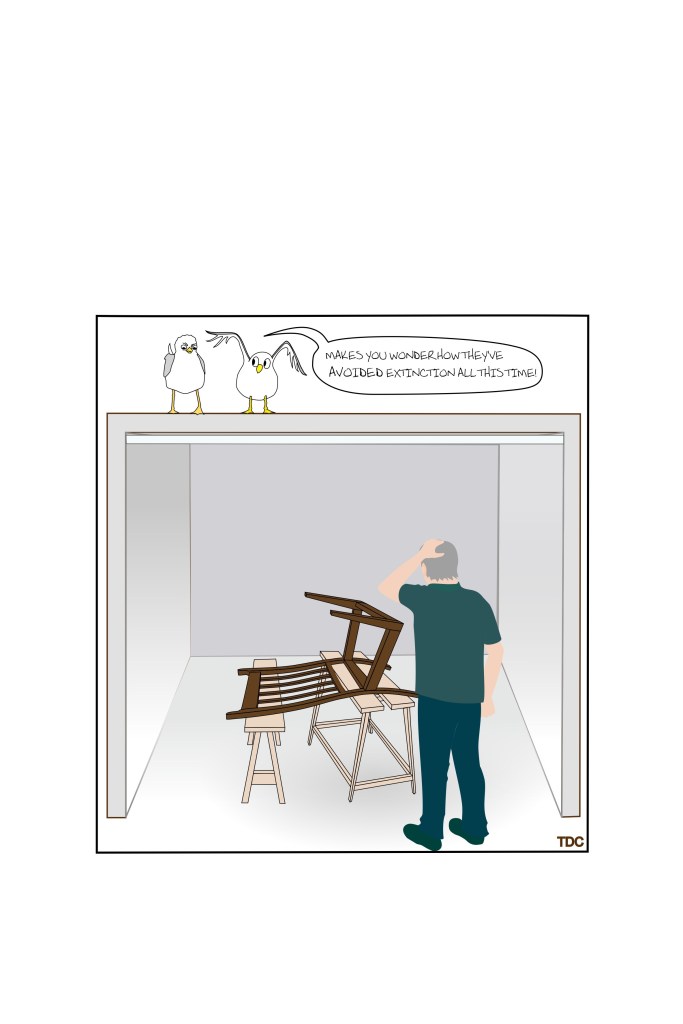
I laid the back of the chair across the two work benches, painted on the glue, and quickly, before the glue dried, lined up the seat-and-front-legs structure. I hammered it on with a two-pound lump-hammer. It seemed beautifully firm.

I breathed a sigh of relief, stood back and admired the finished product.

(see below)