
The Chair

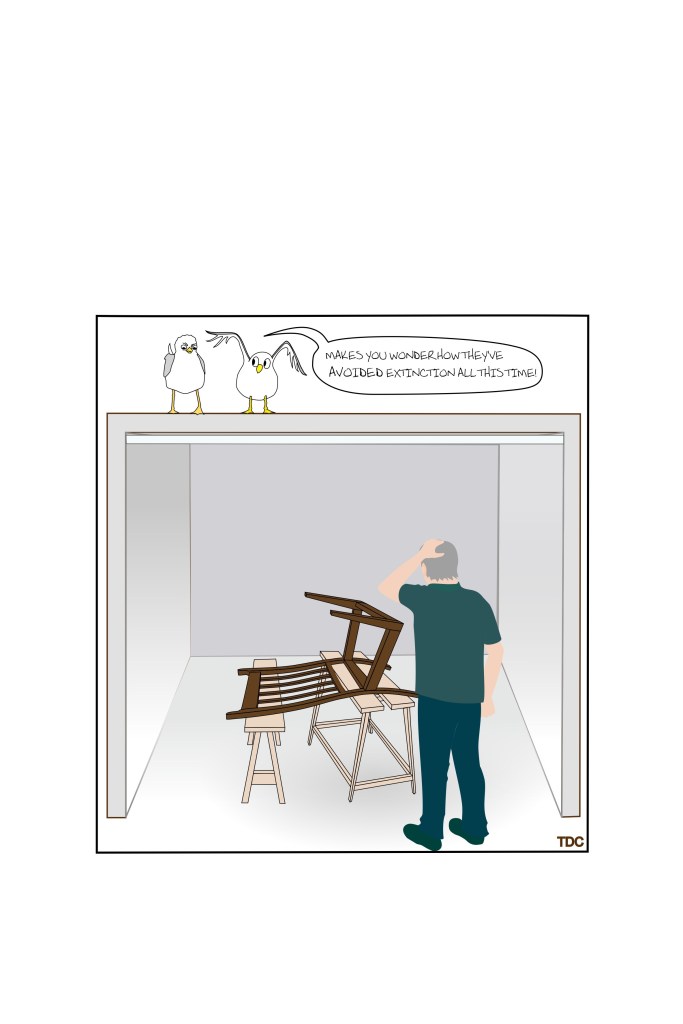
A long time ago a kind lady gave us some old dining chairs. She was ninety and she was downsizing. The chairs were classic. We’ve had them for many years. All of our family and most of our friends have sat on those chairs. Some of them have suffered from the increase in size and weight of the bums they bear, the chairs I mean, not the friends (although there are some options where the words might be appropriate whichever way around they’re written). The chairs have had to put up with the increased loading whilst not getting any younger themselves. One of them had developed a serious wobble. I decided to fix it.

The garage was empty. Empty of a car that is. Its usual occupant was convalescing after some serious renovation.

It’s almost pleasant, working in a dry, uncramped space – that’s a new word by the way, Google doesn’t recognise it and it’s not in the Concise Oxford English Dictionary (but it jolly well ought to be!) and my two workbenches stand, vices agape, eagerly awaiting their limelight moments.

There were some rusty old screws in the fillets where the chair-seat-frame is attached to the back legs but they came out surprisingly easily. Any glue that might once have added strength to the joint had long since crumbled away, so the seat and front legs were quickly separated from the back and back-legs structure.

The dowels were all broken, so the two parts of the chair had been hanging together on the rusty screws. Of course there was no hope of removing the broken dowels and no means of perfectly aligning my hand-drill to drill out the old stubs. No choice but to do it by eye. First though I had to ‘get some dowelling’. A fairly quick search on Google identified quite a few nearby sources of 9mm dowelling rod but no 10mm. How strange I thought. Finally I had to settle for a pack of 200 40 x 10mm wooden dowels from, Screwfix. There are three dowels per joint, I only needed six.

But six dowels means twelve holes to be drilled. With some trepidation – but no choice if the job was to be done ­­- I carefully filed off the broken, sticking-out splinters and lined up the drill. I was amazed at how well that little exercise went.

Common sense says put the dowels in and see if it all lines up. I didn’t dare. The dowels were such a tight fit I thought I’d never get the joint apart again to paint glue onto the flat bits of the joint.

I laid the back of the chair across the two work benches, painted on the glue, and quickly, before the glue dried, lined up the seat-and-front-legs structure. I hammered it on with a two-pound lump-hammer. It seemed beautifully firm.

I breathed a sigh of relief, stood back and admired the finished product.

(see below)
Dead-Heading the Roses by the Garden Gate

That doesn’t mean that that the garden gate wrote this! Only that the roses that needed dead-heading are by the garden gate.

I’d just got up, hadn’t even had a cup of tea when I was suddenly struck by the urgency of the requirement to ‘dead-head’ those roses by the front, garden gate. They are truly lovely roses, a beautiful, pale yellow with a scent that would make Mr Chanel jealous.

 But once they’re ‘over’ they’re like Cinderella after midnight, they need to disappear. 

I put on some shoes and walked down the back garden path to get the plastic basket that serves as a trug. It was full. Full of dying bits of plants that our lady-gardener had failed to empty onto the compost heap. So, sighingly adding yet one more to the lengthy list of chores that I’m responsible for, I picked up the basket and walked to the gate in the fence behind the garage which opens into a little copse. Well, actually it’s a few trees bigger than a little copse, I think. The Concise Oxford English Dictionary defines a copse as a small group of trees. Google doesn’t even know what a copse is!

Anyway, this group of trees is like a giant hedge, about four-hundred yards long and anything from fifteen to thirty yards thick and I can’t find a descriptive word that fits between copses and woods, but by now you’ll know what I’m talking about.

I looked through the fence. It was immediately obvious why the gardener hadn’t emptied the plastic trug. A little way beyond the gate there is a branch-path (in the sense of a branch-line of a railway network) which leads off the main path to the compost heap. The branch-path was impassable. Stingers have been prolific this year – here they were four feet high, leaning in over the path from both sides: jagged leaves, bristling with poisonous barbs, looking at me, smiling, waiting…

“Ha!” I said, “You don’t scare me!”

Not true of course, bravado. At least until I’ve got some protective clothing on.

I went back into the shed, dug out my wellies from under the workbench, behind two bicycles, asking myself as I did so why they can’t be kept in the middle of the shed floor where I’d left them the last time I used them. My stuff is always disappearing into drawers and cupboards. Anyway, that’s another matter.

I checked my wellies, for scorpions, by turning them, one-by-one, upside down and banging them on the floor – a habit I picked up in Oman when I worked there. Sometimes, it was believed, scorpions would crawl into one of your boots while you slept, with the intention of attacking your foot with a fatal sting when you put it in it in the morning (maybe that’s where the expression comes from?). Anyway, it’s worked for me all these years, I’ve never found a scorpion in any of my boots.

As well as putting my boots on I took thick gloves from the glove box and unhooked the old combat jacket that hangs on a nail in the shed wall and put them on. The issue with the nettles was going to be combat.

Armoured now, I turned the wheels in the combination lock, opened the gate and went through.

This time the nettles didn’t look quite so bloodthirsty, they’d lost a bit of their confidence. Quite right, I was dressed to kill.

I grasped the first three stems (traditional: ‘grasping the nettle’(s)) and pulled them out of the ground. They, and the rest of the avenue, and the dead and dying plants in the plastic trug raised the level of the compost heap a little higher.

Then, as I walked back along the branch path. I couldn’t help noticing that the main path – which leads on through the copse to the field beyond – was also overgrown and needed cutting back.

‘Well’ I thought, ‘I’m dressed for it!’ So that’s what I did next. It wasn’t a quick job. As well as nettles there were brambles, clumps of a fast-spreading, variegated green and white grass, ‘sticky’ chick-weed and even young trees.

Before I finished the cook called me in for breakfast.

I’ll dead-head the roses by the front gate tomorrow.

Early Morning Cup of Tea

I woke up four times in the night. The fourth time I took the hint and got up.

I went downstairs into the kitchen where I took the tea things – you know: mugs, tea bags and stuff – out from where they hide when not in use, and put the kettle on. ‘While it’s heating up’ I thought, ‘I’ll go and ‘dead-head’ the yellow roses by the front garden gate.’ I’d been thinking about that for a couple of days.

I opened the front door and was immediately confronted with the bountiful bough of beautiful white roses, which hangs down in front of the door. ‘That’ I thought, ‘is a higher priority than the roses by the gate.’  I needed to do something about pulling it up a little higher, so that the postman wouldn’t need to duck to push letters through the letterbox, but there’s a pigeon nesting in the cotoneaster bush which is next to, and intertwined with the rose bush, and I hadn’t wanted to disturb her. But… she wasn’t on the nest and I couldn’t see any eggs (which aren’t difficult to see in the loose pile of scruffy twigs that pigeons think is a nest), ‘so’ thought I, ‘I’ll do it now!’

I went down to the shed to get the folding steps – which would be necessary to enable me to reach high enough to move the wire hook that holds up the main branch of the rose-bough to a point further along the branch thus lifting the bough higher.

Now, the hook in the wall (hitw) – onto which the loop of clothes-line which is attached to the hook-which-holds-the-bountiful-bough-up (hwhtbbu) is hooked is an upward pointing hook so, as long as the pulling force emanating from the hwhtbbu was in a horizontal or downward direction all was well and the bough was held up, but, as you will already have gathered, the bough of beautiful white roses has grown, not just upwards but just bigger, all-around. And heavier, so it sagged.

I unfolded the step, stood on it, and lifted the bountiful bough up with my left hand whilst unhooking the hwhtbbu with my right and moving it further along the branch. Slowly I lowered the bountiful bough until the branch rested in the crook of the hwhtbbu.

‘Just right’ I thought.

Then there was a ‘pinging’ sound. The branch slumped, lower than it was before, and the hwhtbbu dangled uselessly on the now limp loop of clothes line.

‘Of course’ I can hear you thinking, ‘the direction of pull with the hwhtbbu now further up the branch, in relation to the hitw, is now slightly upward so the loop was bound to slip off.’

I climbed off the step and fetched a pair of pliers from the kitchen tools drawer, (I know that pliers are not normally classed as kitchen tools but the term ‘kitchen tools drawer’ is as it is because it’s in the kitchen not because pliers are kitchen tools). I replaced the loop of clothes line into the crook of the hitw, and bent the hook shut. (That’s what the pliers were for, see?) “Now try and escape!” I said to the piece of clothes line. It looked quite sheepish dangling there, until my right hand grasped the hwhtbu and pulled it to hook it around the main branch of the bountiful bough, which my left hand had lifted to meet it, further up the branch than it was before.

I climbed down from the step and stood back to admire the results of my efforts. The approach to the front door was white with fallen rose petals, as if for a visiting deity, I walked up and down a couple of times so that the transcendent beauty wouldn’t be wasted, then I fetched a dustpan and brush, swept up all the petals and threw them in the compost bin.

The postman will only have to bend a little bit now. I will point out to him that he might consider the considerable time and effort expended, largely for his benefit, as his ‘this year’s Christmas Box’ in advance.

Old Poem, Old Home

This is the house I lived in from when I was born till I went to university, aged eighteen – my parents moved out three years later. I wrote the poem in 2004, after visiting the old town for a school friend’s silver wedding anniversary party, but didn’t have a current photo of it till last week, when my daughter and son-in-law happened to be passing the area and looked it up.

Well, evidently the tree that wasn’t there in 1974 but was in 2004 is still there, and even bigger than I remember. What staggers me most is the fact that it’s seventeen years since I wrote this poem.

I wasn’t writing a lot at that time. It was another year before started a creative writing course, and then a blog. I used to be quite proud of this poem – it’s in my (self) published collection, ‘Beachcombing – but then I got a bit embarrassed by it, and thought maybe it’s a bit too sentimental.

Anyway, here it is:

How long does it take to grow a tree?

How long does it take to grow a tree?
I stand before the house where first I grew
And stare in wonder at your size, your strength,
Your permanence.  The wrought iron gate is gone,
The crumbling wall replaced by livid brick,
The house is smaller than it was, and in
My memory I find there is no trace
Of your existence, even as a sapling.
Yet now your branches tap
The window where I leant and dreamt of
Wider worlds and broader skies.

How could you be here, and I not know?
Maybe you have a longer claim than mine
To this place.  Thirty years perhaps,
To twenty that I spent.  The Queen of May,
Your shining glory will return each year
To light the month that shares your name.
My beauty blossomed once, and faded then.
My branches tend to fruit now, not to flowers,
My seedlings spread their roots in other soils.

How long does it take to grow a woman?
Half a century gone, yet still I strive
To push towards the light.  My roots dig deep
And greedily draw the nutrients to my leaves
Unfurling in the loving of the sun.
They grow and wither, fade and fall away,
Yet new ones come, and still I stretch on up
Until the lightning strike, or fungus plague,
Will topple me, returning to the earth.
And in my inner cortex, sap and wood
I know that I am still the girl who grew
And blossomed in the place where you now stand.

Linda Rushby 2004