
Erwin Rommel once said (memorably for anyone in the military) ‘Time spent in reconnaissance is seldom wasted’. He was absolutely right but I think he should have inserted ‘thorough’ between ‘in’ and ‘reconnaissance’.
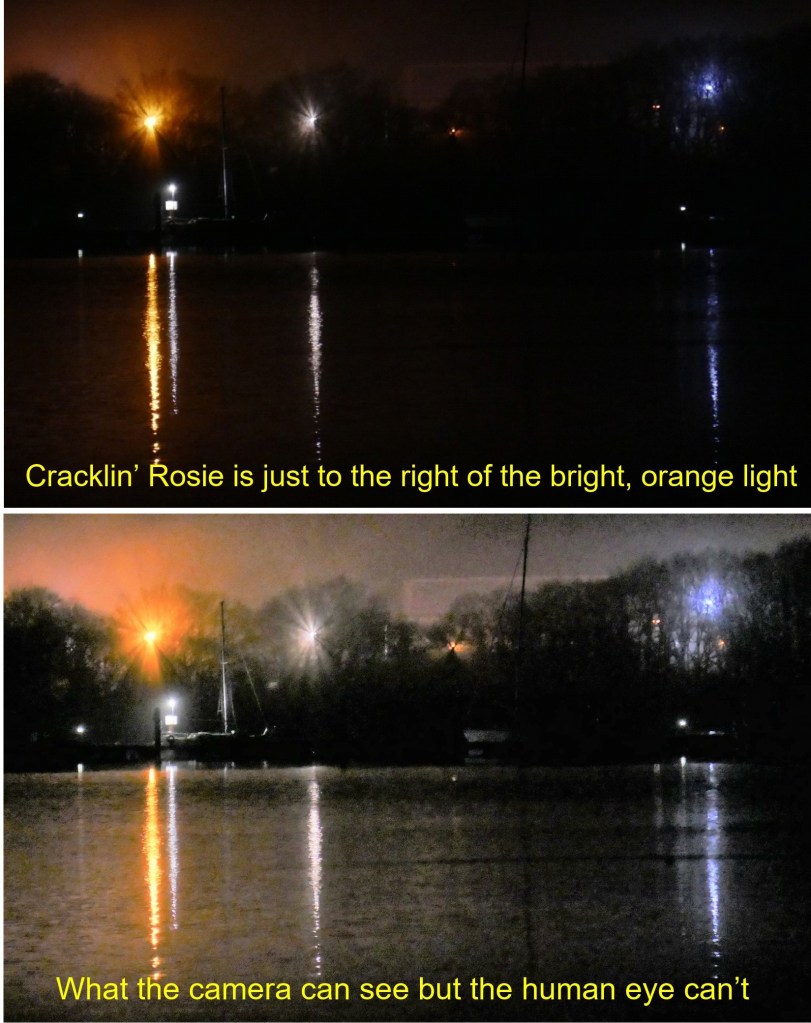
Some time ago, when we were still allowed out, Ida, my wife, and I reconnoitred (went for a walk along) the bank on the north side of Fareham Creek. I wanted to identify a spot where, if it ever became necessary, I could launch a dinghy and row across to Cracklin’ Rosie moored to a pontoon on the far side.
It did become necessary, I thought, some weeks after normal access was closed because of Covid 19 restrictions. I couldn’t get to my tender either, so I invested in a little inflatable dinghy – a beach toy really but I judged that it would get me across the creek and back.
I needed gentle winds and a tide high enough to reach the banks of the creek. I looked at the weather and the tide times. On the morning when a gentle wind was forecast, high tide was an hour before dawn.
The alarm buzzed at half-past-four. I tried hard not to wake Ida, but by the time I got downstairs she’d made a cup of tea. Then she came to help me load the dinghy into the car. Ask me later why I didn’t load it before we went to bed.
I wore my swimming shoes in anticipation of my feet getting wet, and sailing gloves, which leave the fingertips exposed – for dealing with knots or snap-shackles – which, after a while, they can’t because they’re frozen stiff.
The roads were empty so it was an easy drive.
I parked, put on my lifejacket, pulled the dinghy out of the car, oiked it onto on my back and started walking. Moonlight made it reasonably easy to see the big puddles in the gravel path, but they were impossible to avoid without venturing into the dark mass of bushes to one side or the other, so I walked through them. Swimming shoes are entirely suitable for walking through puddles, but they’re not good at keeping wet feet warm. I suppose I should have counted myself lucky that the puddles weren’t frozen.
The trees and bushes gave way to open grassland.
I thought walking on the grass might be more comfortable than on a gravel pathway. My feet sank into the waterlogged ground. I squelched along for a bit before deciding that the gravel path, with its lake-sized puddles was a better choice.
Suddenly a dog started to bark, a deep woofing sound that tells you that it’s a big dog. The dark shape of a man ahead of me shouted something I didn’t catch. The dog was invisible, except for its eyes which were reflecting the moonlight. It was bounding back and forth, barking, obviously at me. The man called and the pair of them rapidly walked away and merged into the blackness.
The moon was reflected on the water, and gave some light to the broken concrete slabs that armour the earthen bank of the creek. The rocks – I’ll call them that because they were stone and of irregular shape – were jumbled, wet and slippery. That’s when Rommel’s words came to mind, our reconnaissance should have included the identification of a decent pathway down to the sea.
It wasn’t easy. Holding the dinghy with my head and one hand left me with two feet and the other hand to negotiate the assault-course obstacles down to the water. That, of course, meant balancing with two limbs whilst negotiating a firm spot for the third each time I wanted to move.
I slithered and slipped down to the water and launched the dinghy. It sat perfectly still on the surface of a perfectly calm sea. Not wishing to risk damaging the bottom on the nasty rocks I pushed it out a little way and waded in. I’d rolled my trousers up to my knees, so that’s how deep it was when I flopped into my little boat. Instantly my bum felt wet. ‘No!’ I thought, ‘not a leak…’ But it didn’t get any worse so I put it down to water emptying out of my shoes and running down to the lowest part of the boat – the big dent made by my bottom.
I grasped the oars and began to row.
Cracklin Rosie was only just across the creek, five-hundred metres away – no distance at all.
We’d covered the first hundred metres or so and I was beginning to put my back into the rowing when there was a sudden crack! The lower half of my left oar floated away in the blackness.
‘Oh dear’ I said aloud, an expression which springs to my lips quite frequently of late, when some random, or not so random, part of one of my endeavours comes to grief.
‘Oh dear!’ I said again.
I could say that I was up the creek without a paddle, a metaphorically appropriate expression but not quite true because I still had one oar. Just rowing though, wouldn’t have been any good unless I’d wanted to go round and round in circles, which might have attracted the attention of the harbour security patrol. But it was still dark, I wasn’t showing any lights and I didn’t want to be run over by a police launch.
Fortunately, I had learned to paddle a coracle, with one oar – which is normal for coracles – many years ago. So I began to paddle back towards the shore. I didn’t want to risk the demise of the one remaining oar whilst attempting to complete my journey across the creek, in fact I was treating it rather gently just to get safely back to where I’d started.
The man in the moon smiled down completely unperturbed.
When I (thankfully) reached the shore, I rolled out of the boat onto my knees, stood up, grabbed the boat and slithered my way up, over the rocks, pulling and pushing the dinghy as I climbed.
I walked back over the soggy grass and through the puddles on the path as fast as I could. I was pretty cold by now and I wanted to keep the blood circulating. I reached the car, put the dinghy down and struggled to open the zipped, trouser pocket in which I’d safely stowed the keys. There are three pockets on that side of these trousers and with the sense of touch completely frozen out of my fingers and no visibility in the tree-shaded car park it was a struggle. I began to imagine dying of cold inches away from the inaccessible car heater or knocking on the front door of the nearest house and, should I be lucky enough for someone to answer, asking some sleepy, possibly angry, person to fiddle in my trouser pocket.
But eventually I got into the right pocket, opened the door and started the engine. The rest was relatively easy: pushing the dinghy into the car, taking off my sodden gloves and shoes, even managing to put a piece of towel down to protect the driver’s seat from the probably muddy seat of my trousers.
The interior of the car was slightly warmer than the air outside. I spun around and headed for home. The roads were still empty and the heater began to heat and it wasn’t long before I was in a hot bath.

 Southsea Storytellers